Ditapis dengan
Algebra programmiert 4: Division Von Termen
- Edisi
- 1
- ISBN/ISSN
- .
- Deskripsi Fisik
- 72 hal.: gmbr ; 22, 5 cm.
- Judul Seri
- -
- No. Panggil
- 512.002 87
- Edisi
- 1
- ISBN/ISSN
- .
- Deskripsi Fisik
- 72 hal.: gmbr ; 22, 5 cm.
- Judul Seri
- -
- No. Panggil
- 512.002 87
Algebra programmiert 1: Grundbegriffe Der Algebra - Grundaquivalenzen
Inhaltsverzeichnis : Einfuhrung in die Arbeit mit dem Programm 1 1 Rechenausdruck, Zahlenwert, Wiederholung des Rechnens mit Klammern sowie der positiven und negativen Zahlen 11 2 Leerstellen und Zahlformen 56 3 Leerstellen und Zahlformen (Fortsetzung) 86 4 Wertetabellen …
- Edisi
- 1
- ISBN/ISSN
- .
- Deskripsi Fisik
- 112 hal.: gmbr ; 22, 5 cm
- Judul Seri
- -
- No. Panggil
- 512.002 87 HEI
Algebra programmiert 2: Termersetzungsregeln Und Termumformungen
Inhaltsverzeichnis : 1 Wie man aus Grundaquivalenzen neue Termaquivalenzen gewinnt 1 2 Ersetzen von Teiltermen 46 3 Termvereinfachungen 94 4 Termumformungen durch Ausmultiplizieren und anschiliessende Termvereinfachung 158 5 Umformung von einfachen Termen, in dene…
- Edisi
- 1
- ISBN/ISSN
- .
- Deskripsi Fisik
- 112 hal.: gmbr ; 22, 5 cm.
- Judul Seri
- -
- No. Panggil
- 512.002 87 HEI
Algebra programmiert 3: Binomische Formeln
Inhaltsverzeichnis : 1 Zusammenfassung von Produkttermen mit mehr als einer Lehrstelle 2 Zweckmasiges Ordnen von Leerstellen in Produkttermen 26 3 Hochzahlen als abkurzende Schreibweise fur besondere Produktterme 47 4 Produkte von Summentermen und ihre Umformung 97 5 Die Binomialformeln als Termaquivalenzen …
- Edisi
- 1
- ISBN/ISSN
- .
- Deskripsi Fisik
- 154 hal, gmbr, 22, 5 cm
- Judul Seri
- -
- No. Panggil
- 512.002 87 HEI
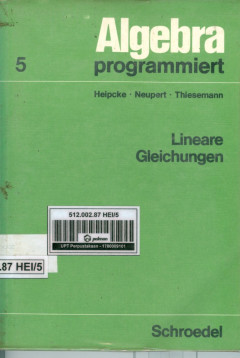
Algebra programmiert 5: Lineare Gleichungen
- Edisi
- 1
- ISBN/ISSN
- .
- Deskripsi Fisik
- 108 hal.: gmbr, ; 22, 5 cm.
- Judul Seri
- -
- No. Panggil
- 512.002 87 HEI
- Edisi
- 1
- ISBN/ISSN
- .
- Deskripsi Fisik
- 108 hal.: gmbr, ; 22, 5 cm.
- Judul Seri
- -
- No. Panggil
- 512.002 87 HEI

Algebra 2 Equations Formulas And Graphs
This book describes how to solve equations, both graphically and algebraically. It considers the graphical representation of inequalities or orderings; how to use formulas to solve equations; how to measure and interpret the gradients of linear and non linear functions. Finally, it describes how to solve maximising and minimising problems using linear programming. 1 Equations and Orderings …
- Edisi
- 1
- ISBN/ISSN
- 0 521 24332 8
- Deskripsi Fisik
- vi, 90 hal, : gmbr, ; 23 cm.
- Judul Seri
- -
- No. Panggil
- 512 SMP
Algebra
1 Classification of Equations 2 Transformation of Equations 3 Conditional Equations of First Degree (Linear Conditional Equations) 4 Conditional Equations of Second Degree (Quadratic Equations) 5 Conditional Equations of Third Degree (Cubic Equations) 6 Theorem of GAUSS 7 Regula Falsi (Method to Evaluate Approximate Values as Solutions of an Equation)
- Edisi
- 1
- ISBN/ISSN
- .
- Deskripsi Fisik
- 124 hal.; gmbr.; 29 cm
- Judul Seri
- -
- No. Panggil
- R 512 KAP
Trigonometry Unit 4
- Edisi
- 1
- ISBN/ISSN
- .
- Deskripsi Fisik
- 18 hal gmbr 29 cm
- Judul Seri
- -
- No. Panggil
- 512.13 TEC
- Edisi
- 1
- ISBN/ISSN
- .
- Deskripsi Fisik
- 18 hal gmbr 29 cm
- Judul Seri
- -
- No. Panggil
- 512.13 TEC
Mathematics Algebra
- Edisi
- 1
- ISBN/ISSN
- .
- Deskripsi Fisik
- 125 hal ; gmbr ; 29 cm
- Judul Seri
- -
- No. Panggil
- 513 KAP
- Edisi
- 1
- ISBN/ISSN
- .
- Deskripsi Fisik
- 125 hal ; gmbr ; 29 cm
- Judul Seri
- -
- No. Panggil
- 513 KAP
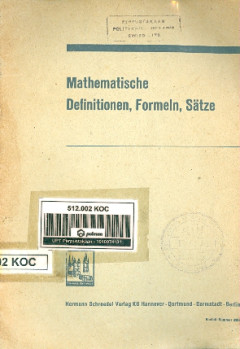
Mathematische, Definitionen, Formeln, Satze
- Edisi
- 1st Ed
- ISBN/ISSN
- -
- Deskripsi Fisik
- 16 hal.: gmb; 22 cm
- Judul Seri
- -
- No. Panggil
- 512.002.87 KOC
- Edisi
- 1st Ed
- ISBN/ISSN
- -
- Deskripsi Fisik
- 16 hal.: gmb; 22 cm
- Judul Seri
- -
- No. Panggil
- 512.002.87 KOC
 Karya Umum
 Filsafat
 Agama
 Ilmu-ilmu Sosial
 Bahasa
 Ilmu-ilmu Murni
 Ilmu-ilmu Terapan
 Kesenian, Hiburan, dan Olahraga
 Kesusastraan
 Geografi dan Sejarah